

Boone County Distilling’s “Eighteen 33” bourbon. Photo: Courtesy Kentucky Distillers Association 
Bottling line at Angels Envy in Louisville. Photo: Courtesy Kentucky Distillers Association 
A taste of Buckner’s Single Barrel at Augusta Distillery. Photo: Courtesy Kentucky Distillers Association 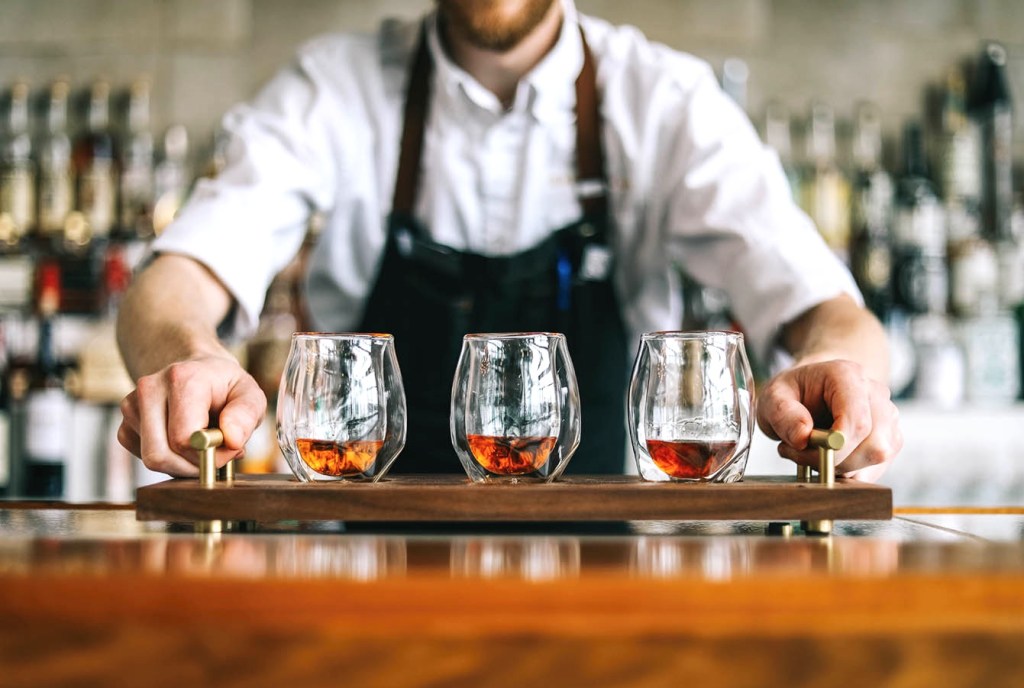
Tasting flight at Bardstown Bourbon Co. Photo: Courtesy Kentucky Distillers Association 
Barrelroom at Boone County Distilling. Photo: Courtesy Kentucky Distillers Association 
The barrel-firing room at Old Forester Distilling Co. Photo: Courtesy Kentucky Distillers Association 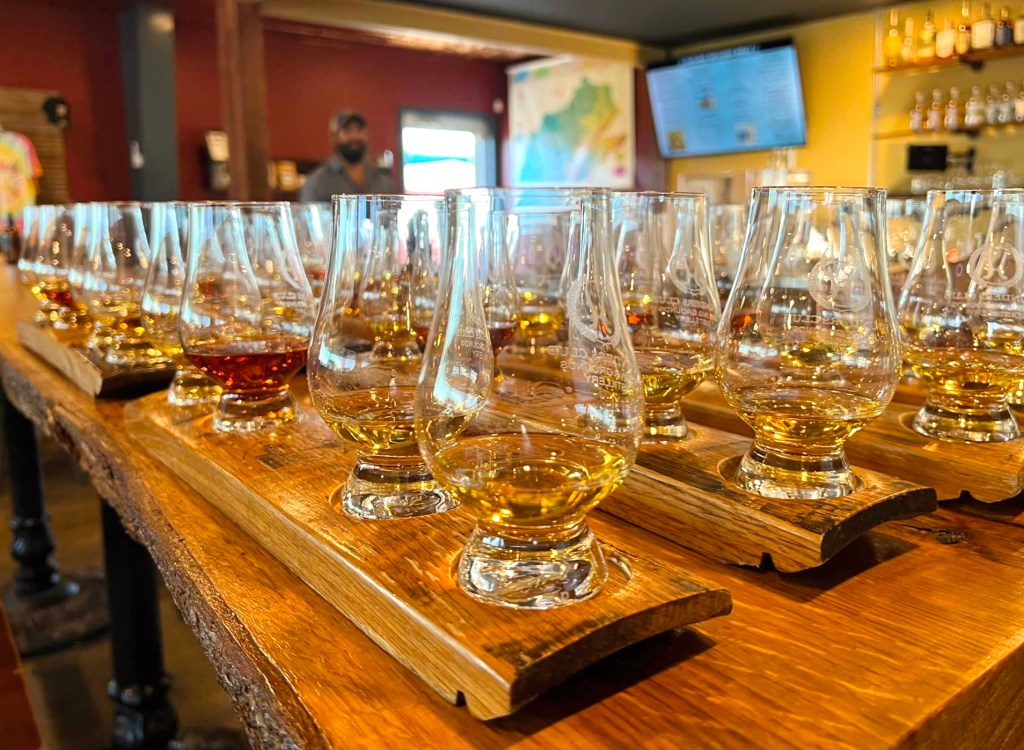
Tasting flights at Dueling Grounds Distillery. Photo: Courtesy Kentucky Distillers Association 
Brewing tanks at Green River Distilling Co. in Owensboro, K.Y. Photo: Courtesy Kentucky Distillers Association 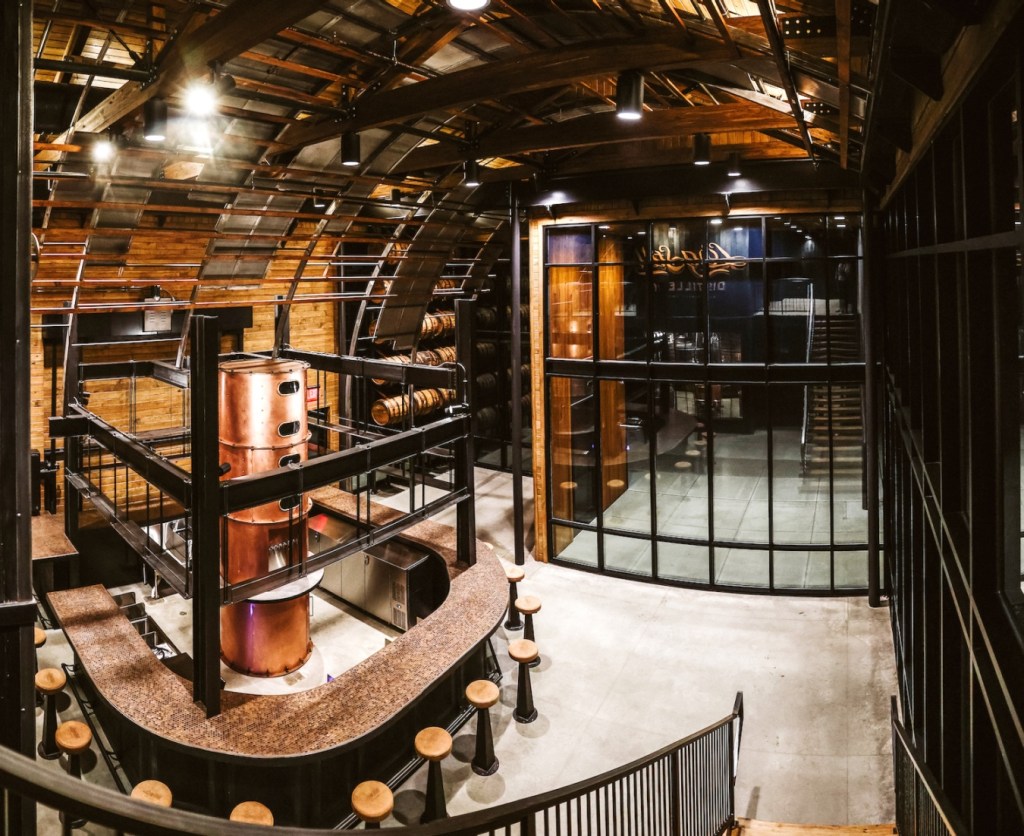
Tasting room at Log Still Distillery in Gethsemane. Photo: Courtesy Kentucky Distillers Association 
Bourbon barrels at Preservation Distillery. Photo: Courtesy Kentucky Distillers Association 
Visitors at Bulleit Distilling Co. can make customized labels. Photo: Aaron Doster/AP Images for The Bulleit Distilling Co.
On the Trail of Kentucky’s Smoothest Sips
Spud Hilton
Food Trail Traveler
There are plenty of mysteries involved in the creation, aging and imbibing of great distilled spirits. Who first thought it was a good idea to boil a potato for vodka? Is the Green Fairy of absinthe real? Why do Canadians spell “whiskey” without an E? The oddest conundrum could be a chicken-and-the-egg thing — was bourbon named for royalty, a county or a street in New Orleans?
While there is plenty of speculation and legend surrounding the naming of barrel-aged whiskey, the best place to find answers is in the Motherland: Kentucky. And it’s unlikely anyone would have better answers to bourbon questions than the distillers on the Kentucky Bourbon Trail.
“Our distillers for the longest time didn’t have an organized tourism program. People would just be passing by,” says Amandalin Ryan, director of Kentucky Bourbon Trail Experiences for the Kentucky Distillers’ Association. “It started with this very informal thing and we decided to invest in an experience that would actually teach people the individual brands.”
The program has been growing ever since, Ryan says. “We are definitely one of the top beverage destinations in the U.S. In 2022 we saw over 2.1 million visits to our distilleries … and on average, people are visiting six distilleries during a trip.”
The “trail” is actually several trails, divided into two different lists, one for the 18 “signature distilleries” such as Bulleit, Maker’s Mark or Four Roses, and a second list that focuses on 28 “craft distilleries” across four regions — northern, central, western and “Bluegrass.” Most of the stops on the trails are within or near a triangle that includes Louisville, Lexington and Bardsville. According to experts at KYBourbonTrail.com, the “ultimate bourbon excursion” would include all 46 distilleries, but it would take a week or longer and cover 950 miles and two time zones.

Similar to stops along tasting trails in popular Wine Country destinations, many of Kentucky’s distilleries also offer food, ranging from small snacks to full restaurant fare. As it turns out, eating regularly along the tasting trails is one of the top tips of surviving the Kentucky Bourbon Trail. Among the others are:
- Make arrangements: “Plan ahead and book your tours in advance,” says Amandalin Ryan of the Kentucky Distillers Association. “Our distillers have been very busy since travel opened back up and we don’t want anyone to miss out on an experience.”
- The Irish call whiskey “the water of life,” but when on a prolonged trail experience involving distilled spirits, actual water is probably your best friend.
- About 60 percent of Kentucky is in the Eastern Time Zone and the rest is in Central. Keep this in mind when making reservations for tastings and measuring estimated time of arrival at stops on the trail.
- Visit the Kentucky Bourbon Trail site online for interactive maps, as well as a downloadable PDF map (see above) that includes the “Signature” and “Craft” trails. Also, there are a multitude of bourbon-related experts on YouTube who post reviews and news regularly.
- Make sure to ask at each distillery the origin or the word “bourbon” and whether it was named for France’s House of Bourbon royalty, Kentucky’s Bourbon County or (the most popular answer) Bourbon Street in New Orleans, which has been around since the 1720s. It’s unlikely you’ll get the same answer from every distiller, but that’s what makes history fun.
One final tip: If you’re a fan of bourbon and the Apocalypse comes, move to Kentucky. Bourbon makers statewide have stockpiled more than 12 million barrels in reserve, which at 266 standard 750 ml bottles per barrel works out to 3.19 billion bottles. That’s roughly 12 bottles for every adult in the United States, based on current population stats.
But why risk it? Make plans to get a taste of Kentucky’s bourbon trails now — just in case.
Spud Hilton is the editor for Food Trail Traveler and host of the Culinary Carpool videos.
 Food Trail Traveler